About six weeks ago, I joined a small group of people who are fellow students at IUPUI and concerned by Indianapolis, Indiana’s stark lack of transportation planning and public transit availability. The group is called Hoosier Progress. Just this evening, we were discussing the differences between Indianapolis and Madison, Wisconsin when it came to commuting options. Madison is laden with bicycles and crisscrossed with a network of bike and foot paths that would make any city in the nation envious.
The likely root cause of this situation is geography. The heart of Madison is situated on a narrow isthmus between two lakes, Monona and Mendota. This is likely what encouraged higher population density, which in turn led to tighter city blocks on the isthmus and smaller residential properties. Madison was founded in 1836. Needless to say, there were few cars on the road and public transportation had not yet taken off. Therefore, there was a greater need to move about the city on foot.
Indianapolis is built on flat, open land, with only a river and a smattering of man-made lakes on the edge of town to determine how things are laid out. There are no natural barriers to determine the size of house lots or the shape of neighborhoods. It also means cheaper land for newer, more land-intensive housing tracts in the suburbs. Like Madison, the older parts of the city have smaller blocks, but this is a relic from a time when few people owned cars and the population was much smaller.
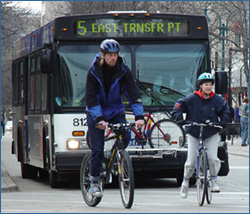 As a consequence of these two different city development paths, Madison has about 50 percent greater population density. The greater Madison area also has about a third the population of Indianapolis, this makes it easier to get from place to place within Madison. Madison also benefits from a comprehensive network of bicycle paths.
When considering Indianapolis’ abysmal public transportation and bicycle infrastructure, there are things to be learned from citys like Madison. Encouraging increased population density when creating or rebuilding neighborhoods can make it easier for residents to go about their day without a car.
Increasing population density would also make it easier to determine where bike paths should be laid. Currently, they are restricted to abandoned rail lines and along major waterways. A comprehensive trail network should connect neighborhood centers, residential areas, and major attractions like museums, parks, and airports.
Indianapolis still has a long way to go when it comes to building out non-automotive traffic infrastructure. However, we do not have to reinvent the wheel (so to speak.) We can look at the ways it is been successfully implemented in other places and try to apply those lessons here.
Neil deGrasse Tyson is an excellent lecturer and public speaker. He is also a great advocate for science and rational thought.
At a PBS/NOVA-sponsored event, he answered a question regarding his belief in the existence of UFOs and extraterrestrial visitors. He began his response by reminding the audience what the “U” in “UFO” stands for and how humans, in a desperate need for answers, will fill in the blanks of our perceptions.
He was quite right in saying that humans are flawed information gatherers. We are forced to rely on precision instruments, repeated observations, the Scientific Method, and comparing observations with others to get a reliable picture of reality.
Perhaps we are not given to naturally processing information reliably, in favor of forming quick conclusions and quick reactions. An animal in the wild is not usually benefited by calm, slow, patient reasoning and analysis. In a life-and-death situations, an animal must react quickly to escape or fight and survive.
I do not blame people for seeing a mysterious light in the sky and instantly filling in all the banks with whatever happens to be on their minds. That is just the way the primal human mind works. However, it is within our power to stop that thought from reaching our lips and sit down and think about what we just saw. I do not know the exact numbers, if they exist, but the odds of seeing a genuine alien spacecraft or their occupants is far less likely than catching a glimpse of Venus or a meteor hitting the atmosphere.
While not an irrefutable piece of logic in scientific circles, Occam’s razor would seem to apply here. “The simplest solution is usually the correct one.”
[youtube=http://www.youtube.com/watch?v=zfAzaDyae-k]
I am the proud owner of an iPod touch and I have to sat that I love it. It is a terrific device for anyone who needs to do online stuff, but doesn’t have time to sit down at a full-fledged computer. It really is a great device, one I find myself missing when I am without it. (I think I might be addicted.)
I hear tech pundits like Leo Laporte and Justine Ezarik bragging about how many pages of iPhone apps they have. I believe they are at somewhere around eight pages, with sixteen applications each, plus four in the dock at the bottom. I got up to four pages, with a few more apps spilling onto a fifth. This was a little overwhelming if I wanted to find a specific app and I could not remember where I had placed it. So I recently connected my iPod touch to my computer and did an inventory of what I needed and did not need to carry around with me. There were lots of easy choices. Before I knew it, I was able to eliminate nearly twenty applications and hyperlinks from my home screen. It was so satisfying to clean house like that and my productivity on my iPod touch has improved noticeably. (Notice Twitterrific, eBay Mobile, and Galcon Lite are now easily accessible on the first page for maximum efficiency.)
Below are screenshots of all three pages of my iPod touch home screen. It’s good.

 Patrick Proctor was here