About six weeks ago, I joined a small group of people who are fellow students at IUPUI and concerned by Indianapolis, Indiana’s stark lack of transportation planning and public transit availability. The group is called Hoosier Progress. Just this evening, we were discussing the differences between Indianapolis and Madison, Wisconsin when it came to commuting options. Madison is laden with bicycles and crisscrossed with a network of bike and foot paths that would make any city in the nation envious.
The likely root cause of this situation is geography. The heart of Madison is situated on a narrow isthmus between two lakes, Monona and Mendota. This is likely what encouraged higher population density, which in turn led to tighter city blocks on the isthmus and smaller residential properties. Madison was founded in 1836. Needless to say, there were few cars on the road and public transportation had not yet taken off. Therefore, there was a greater need to move about the city on foot.
Indianapolis is built on flat, open land, with only a river and a smattering of man-made lakes on the edge of town to determine how things are laid out. There are no natural barriers to determine the size of house lots or the shape of neighborhoods. It also means cheaper land for newer, more land-intensive housing tracts in the suburbs. Like Madison, the older parts of the city have smaller blocks, but this is a relic from a time when few people owned cars and the population was much smaller.
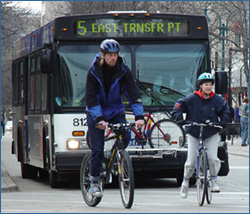 As a consequence of these two different city development paths, Madison has about 50 percent greater population density. The greater Madison area also has about a third the population of Indianapolis, this makes it easier to get from place to place within Madison. Madison also benefits from a comprehensive network of bicycle paths.
When considering Indianapolis’ abysmal public transportation and bicycle infrastructure, there are things to be learned from citys like Madison. Encouraging increased population density when creating or rebuilding neighborhoods can make it easier for residents to go about their day without a car.
Increasing population density would also make it easier to determine where bike paths should be laid. Currently, they are restricted to abandoned rail lines and along major waterways. A comprehensive trail network should connect neighborhood centers, residential areas, and major attractions like museums, parks, and airports.
Indianapolis still has a long way to go when it comes to building out non-automotive traffic infrastructure. However, we do not have to reinvent the wheel (so to speak.) We can look at the ways it is been successfully implemented in other places and try to apply those lessons here.
There is little controversy when discussing the need for more renewable energy sources in the United States’ energy mix, with emphasis on solar and wind power. The controversy begins when it comes to deciding where the physical infrastructure for these energy sources will be placed.
This has led to the (somewhat derogatory) term “NIMBY,” which stands for “Not in my Back Yard.” It describes people who may be enthusiastic about the prospect of the renewable energy industry but do not want its associated physical infrastructure in a place where it will affect the appearance of their properties.
An unfortunate consequence of renewable energy developers being pushed to put more and more wind farms on the grid is that they have become a bit overzealous. Plans and permits are issued quickly and residents who will live nearby these windmill farms ultimately complain. Not all complain, just a few.
This makes it extremely important to get feedback from residents who live near proposed wind and solar farms before beginning any planning on the placement of windmills or solar panels begins. Since we are installing infrastructure that will likely be in place for decades, these windmills and solar power plants will not just be infrastructure – they will be neighbors. It is important to get along with your neighbors, especially when you are trying to improve the public perception of renewable energy nationwide.
If a windmill needs to take a slight performance hit in order to not make a serious impact on the appearance of the landscape, then that is a fair compromise. Saving an unnecessary fight with local residents in exchange for a slight drop in efficiency is not really a drop in efficiency.
Having comprehensive public participation would probably be of more importance in the northeastern states, where population density is much higher than in areas such as the midwest and the southwest. More people would be affected by a new windmill in rural Vermont than in rural Illinois simply because the states are smaller and there is a higher overall population density in Vermont.
If you ever find yourself faced with a “NIMBY,” get them all together and tell them where to put the windmill. They will figure it out.
For those have not seen the Symphony of Science videos yet, I highly recommend you go watch all of them. There are five so far and a new one is added every few months.
In the most recent one, “The Poetry of Reality,” I have found that a few of the scientists in the video think that is “great not knowing”. I understand that all of the phrases and audio clips are taken completely out of context. Even so, I feel that these statements are poorly worded. Surely, Richard Feynman was not advocating ignorance as an alternative to absolute certainty and knowledge. Neither of these are logically tenable positions to try to maintain. Also, both tend to be associated with organized religion.
Absolute certainty means holding a very specific position on a topic and not wavering from it, even in the face of new evidence. An opinion can seem perfectly reasonable at one time, but then will appear more and more absurd to others as time goes on.
Absolute certainty breeds a terrible type of ignorance, willful ignorance. When one is willfully ignorant of reality, they will do everything in their power to avoid newer, uncomfortable evidence. In extreme cases, they will become immune to reason and become a risk to themselves and others.
In order to become inquisitive, one must first admit ignorance where no publicly verifiable evidence exists. Ignorance is not the equivalent of stupidity and it is easy to solve the problem of ignorance. Even if you do not have access to the internet or a library, you can still become a rational, thinking human being.
Also realize that whatever you hold to be true is not invulnerable to new evidence. Be ready to accept that new evidence and incorporate it into your over-arching world view.
Then again, that’s just me. I could be wrong.
Update: If you would like some additional reading, consider Bob Carroll’s “Becoming a Critical Thinker.” It’s a good introductory book to logic and reason applied in the real world.
[youtube=http://www.youtube.com/watch?v=9Cd36WJ79z4]
A few weeks ago, I had a sprited discussion with a friend of mind, Andrew. He successfully made the case to me that short-cut grass is purely ornamental, non functional, and even environmentally harmful. This is echoed in a blog post that Andrew shared with me today.
 Frankly, there are quite a few things that bother me about living in Carmel. The first, most glaring thing is the commute. It takes half an hour to drive to IUPUI from my house. It takes an hour or more to get there by bike. It is very frustrating to have to spend 30 minutes in a car to get to school or work. Not only do I have to drive to work, I am often forced to drive to the grocery store and other business. While these are much closer than the campus, they are still far from my house.
However, these are transportation issues. At home, there is lots of green. Most of that green is in the form of low-cut grass. This grass does not catch rainwater or runoff as effectively as longer grass. Also, because of the shallow root structure in short grass, the roots do not break up and aerate the soil effective, causing the soil under the grass to become compacted and less permeable to water.
In most neighborhoods, there is social, if not legal, pressure to keep grass short and green. Since you have to live near the people next door, simply letting your lawn grow out-of-control is likely not a realistic option.
An excellent way to solve this problem while keeping up the appearance of the lawn is to remove a significant amount of the grass and replace it with plants such as shrubs, bushes, trees, and vines. You could even grow food, though this is probably better suited for the side and back yards. I have seen many houses that use this technique. They are attractive, well-kept, and help retain water and keep it out of the storm drains and water suplies.
 Patrick Proctor was here
