About six weeks ago, I joined a small group of people who are fellow students at IUPUI and concerned by Indianapolis, Indiana’s stark lack of transportation planning and public transit availability. The group is called Hoosier Progress. Just this evening, we were discussing the differences between Indianapolis and Madison, Wisconsin when it came to commuting options. Madison is laden with bicycles and crisscrossed with a network of bike and foot paths that would make any city in the nation envious.
The likely root cause of this situation is geography. The heart of Madison is situated on a narrow isthmus between two lakes, Monona and Mendota. This is likely what encouraged higher population density, which in turn led to tighter city blocks on the isthmus and smaller residential properties. Madison was founded in 1836. Needless to say, there were few cars on the road and public transportation had not yet taken off. Therefore, there was a greater need to move about the city on foot.
Indianapolis is built on flat, open land, with only a river and a smattering of man-made lakes on the edge of town to determine how things are laid out. There are no natural barriers to determine the size of house lots or the shape of neighborhoods. It also means cheaper land for newer, more land-intensive housing tracts in the suburbs. Like Madison, the older parts of the city have smaller blocks, but this is a relic from a time when few people owned cars and the population was much smaller.
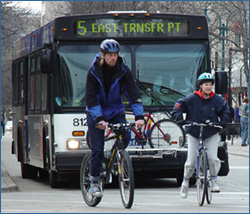 As a consequence of these two different city development paths, Madison has about 50 percent greater population density. The greater Madison area also has about a third the population of Indianapolis, this makes it easier to get from place to place within Madison. Madison also benefits from a comprehensive network of bicycle paths.
When considering Indianapolis’ abysmal public transportation and bicycle infrastructure, there are things to be learned from citys like Madison. Encouraging increased population density when creating or rebuilding neighborhoods can make it easier for residents to go about their day without a car.
Increasing population density would also make it easier to determine where bike paths should be laid. Currently, they are restricted to abandoned rail lines and along major waterways. A comprehensive trail network should connect neighborhood centers, residential areas, and major attractions like museums, parks, and airports.
Indianapolis still has a long way to go when it comes to building out non-automotive traffic infrastructure. However, we do not have to reinvent the wheel (so to speak.) We can look at the ways it is been successfully implemented in other places and try to apply those lessons here.
What matters. Where it matters.
 Copyright ©
The Trustees of Indiana University,
Copyright Complaints
Copyright ©
The Trustees of Indiana University,
Copyright Complaints
 Patrick Proctor was here