Microsoft Office has been a staple of academic and professional life for nearly fifteen years. It was introduced in 1989 for the Mac and later in 1990 for Windows. Since then, its feature set has grown. However, it would seem the Office is suffering from a rather advanced case of feature creep. 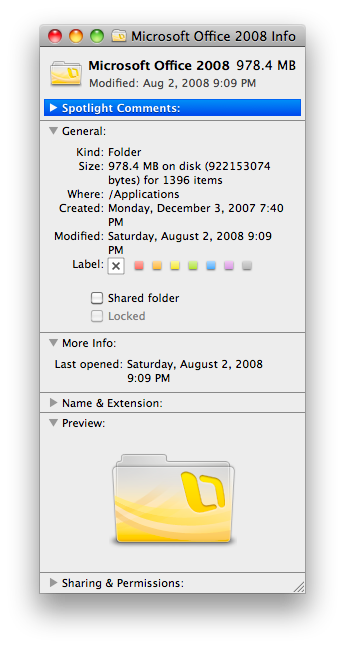 Office 2008 is installed on this MacBook and it takes up nearly a gigabyte of hard disk space. When launching Microsoft Word, it take take as long as 60 seconds to launch.
The cost of the software package is not that great, either. If you buy a license for the Windows version, it could cost you between $150 and $500. If you buy the Mac version, you could end up paying $130 or $350.
Microsoft clearly needs to drop their prices and slim down their products. There are features in Excel and Word that I wouldn’t be able to begin to explain. Most people need a word processor that is a word processor. It should let you write a letter or a paper, save it, and print it. For me, that would cover 99% of my needs. The same goes with spreadsheet programs.
Microsoft Office is looking less and less attractive to me. Programs like Open Office are open source and completely free. Apple’s iWork, a direct competitor of Office on the Mac has a great deal of polish and looks to be designed with average users in mind, rather than businesses.
Microsoft needs to make its software much more minimal and much more nimble. It may be a smart move for them to make if they want to help push resource-limited netbooks that might struggle to run large programs like those found in Office.
In the Indiana University School of Informatics, the Media Arts and Sciences program seems to place a high level of emphasis on Flash and ActionScript development. This is extraordinarily frustrating for someone coming from a programming background.
 Flash has some fatal flaws that should exempt it from being so prominent on the web. However, like Internet Explorer 6, Flash is one of those things that can make life more difficult for a web developer.
System resource usage
Flash makes heavy use of the client machine’s processor. Every time I go to a web page with Flash in it, my MacBook’s fan cranks up higher than it goes in any other situation. There are benchmarks confirming this. Flash simply does not run efficiently on any platform
Proprietary standard
Open source advocates may howl at Flash’s closed architecture. In this case I would agree and at the same time, not care. Adobe has made it so that the only practical way to create a Flash program is with Adobe’s own proprietary and very costly software. There are alternative Flash players to Adobe’s Flash player. Still, the only way to develop Flash programs is through Adobe. If Adobe wants to create a high barrier to entry to their own product, then that is their call. However, Adobe has limited any video playback in Flash to its own .flv format and none other.
Usability
Flash, as a web tool, breaks several accessibility conventions. People with poor vision are essentially left out in the cold. Where screen readers can help a blind person get usable information from an HTML page, it is completely useless with a Flash object embedded in the page. By default, Flash does not have options to change things like saturation, brightness, or color. Flash just is not user-friendly for users of the web who cannot see well.
What the School of Informatics needs to do
I am certainly not advocating that the Media Arts and Sciences program completely abandon Flash. Like any other tool, Flash has its own purposes. However, I feel there is simply too much emphasis placed on it. I am only taking five MAS classes for a cognate and two, possibly three, of them will be heavily Flash classes, even with names like “Multimedia Design” and “Interactive Design.” The MAS program needs to stop teaching as though Adobe Creative Suite is the only way to touch the web.
Flash just is not suitable as a web standard. It uses too many system resources, prohibits open development, and leaves out a large portion of the web-using population. Until these things change drastically, Flash will be a limited tool with an ultimately limited future.
Apple introduced its first device to use multitouch at Macworld 2007 in San Francisco, the iPhone. The first-generation iPhone was released the following June. Since then, Apple has steadily added multitouch to their MacBook line of laptop computers. Now they have brought multitouch to their mice with the Magic Mouse.
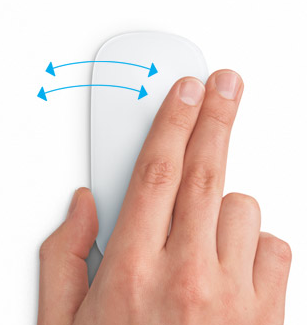 I am sure that this has been under development at Apple for some time. According to Apple, the company spent a couple of years working on the iPhone before they announced it. After they have a successful multitouch interface working and out in the marketplace, how much effort could it really take to move it over to trackpad on a laptop? After the MacBook Pro got the multitouch technology, I cannot imagine it would take much time to make it a feature in all of Apple’s other laptop models. I think that Apple spread out the implementation of multitouch in its laptop line to keep notebook sales nice and steady over a couple of years.
Maybe I am wrong though. I could be completely unfair to Apple’s hardware engineers who, I am certain in any case, worked very hard to make multitouch a reality on so many different products. There probably were some difficulties with each successive new multitouch product and they needed time to hammer out all of the hardware and firmware bugs before they could push it out.
Any company needs time to develop new hardware. I accept that. In the case of Apple, they make sure that the software and the hardware work perfectly together. However, that does not mean that it is wise from a marketing perspective to push out a given feature, especially one as novel as multitouch, on too many products too quickly.
I am a middle-class, white, 22-year old male living in the United States and I only recently received my first cell phone. The reason that I held off for so long was because I never had the need for a cell phone. It just was not something that I ever felt was lacking in my life. For many years my friends all looked at me as though I was nuts when I mentioned I did not own a cell phone.
I believe in simplicity. Less is more in my book and if you are about to bring something new into your life, like a cell phone, ask yourself, “Is it necessary and if it isn’t, will it give me some kind of happiness?” Every time I asked myself that question, the answer was an unequivocal “No.” I say a cell phone as just another bill and an another excuse for people to whine because I choose to ignore them sometimes.
Why do you have cell phone? Did you just get one because it is in vogue to have one? Do you have one just because it is expected of you? I know I bought mine because I needed to be able to make phone calls when I did not have access to a land line. It seems that sometimes people just buy their cell phones without considering whether it is necessary.
If you do have a cell phone, consider how you use it. If if rings, do you trip over yourself to pick it up of do you flip the ringer switch, finish what you are doing, and get back to it later? Perhaps you are doing something important, like driving, and taking or making a phone call in the middle of it would hinder your ability to do both.
Consider why you have cell phone and how you use yours. It seems like a central part of modern life for many people. Perhaps we should all think more deeply about its impact upon our lives.
I have had experience with several programming languages over the last few years, especially in the last two days. So far this weekend, I have used ActionScript, C, Objective-C, Assembly language, PHP, Ruby, and even TIBasic. However, I feel I am lacking in many of the languages. I feel confident in Ruby and somewhat so in PHP and Obj-C. For the most part, though I have lacked focus. For the moment, I am just trying everything out.
Something that I have learned over the past few months while searching for a job is to specialize. In the tech sector, especially, specialization will help you. The problem lies in making the right decision on what to specialize in.
Indianapolis may be trying to be the Midwestern Silicon Valley, but they are far from it at the moment. There are only so many entry-level programming jobs in the area to go around. Often, they are looking for skills like ASP.NET or C# because most of the development that is going on in central Indiana is Microsoft based.
This can leave you with a big problem on your hands if you are only interested in using easier-to-use open source programming frameworks, like CodeIgniter with PHP or Ruby on Rails. This can leave you in a difficult position if you are trying to make a living in an area where none of these technologies are being used by local development shops.
If you are interested in becoming a developer, talk to local developers in the area where you want to live after graduation. Find out what they are developing in, be it PHP, Rails, .NET, or something else. If no one is developing in what you want to develop in, you have two options. The first is you could go freelance, which would be very difficult, especially immediately after leaving college. The second option is to move to an area where there is a development shop developing in the language/framework that you want to use.
Friedrich Nietzche once advanced the idea that there are two mentalities in groups of people: slave mentality and master mentality. Slave mentality is characterized by willingness to cooperate and lack of desire to seek power or take charge. Master mentality is characterized by the desire to take charge of a group or people. In the past, especially when slavery was prevalent in western civilization, this master/slave mentality was less metaphor and more reality.
Nietzhe said that most people in western society have adopted a slave mentality, while a few have adopted the master mentality. It is the people who have adopted the master mentality that tend to be the most driven and ambitious. They are the CEOs of the world. They are the leaders.
The majority of us have adopted the slave mentality. Few people want to take charge. No one wants to rock the boat. A person with a master mentality is almost like a wolf among sheep.
If you find yourself hesitating to take charge of a situation when it is necessary, remember that most people in modern society have the slave mentality. They are ambitious only in their personal lives and in the lives of those close to them. A truly ambitious person concerns themselves with the lives of everyone, not just themselves. They want to have some measure of control over what everybody does or how they live.
Case in point would be tech industry CEOs. They want to make sure that their product is being used daily be everyone. Those CEOs have ambition. Most people do not really care what brand of computer they use or if they use Google, Yahoo, or even Lycos for web search. It falls to the master mentality of the CEO to try to get as many people to use their stuff, rather than the competitors’ stuff.
If one adopts a master mentality in modern society, they have a better chance of getting ahead of his or her peers.
When does something become obsolete? I suppose the simplest definition of the word is when that thing becomes completely useless.
I collect old Macs. The oldest one that I own is a Macintosh SE which was manufactured in 1988. It is nearly as old as I am, yet it still functions perfectly. While are networking cards available for the model of Mac, this Mac does not have one. The computer cannot connect to the Internet directly, which we generally consider to be the benchmark of usefulness for modern computers.
The Internet, however, is not the only way a computer can become useful. I used my Mac SE to type out this blog post. Granted, it was necessary to transfer the file to a more up-to-date computer with a high speed Internet connection and blogging software. All I needed to write this blog was a 21-year old computer, an 800L floppy disk, Microsoft Word 4.0, and an ADB keyboard and mouse.
My attachment to old things does not end there. I have been driving a 1986 Honda Accord for the last five years. More than three of those years were spent commuting twenty-five miles per day between home, work, and campus. I have not moved on to a car that was built more recently because there has been no need for me to. The car that I drive right now is still perfectly suited for the task that it was built for.
My car consistently fails to break down and always gets me to where I need to go. My old Macs provide me with a distraction-free place to get some writing done. I suppose my point is that it does not make sense to throw something out or replace it if it still has utility.
 Patrick Proctor was here