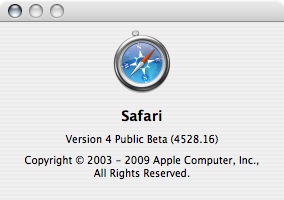
Apple released the Public Beta of version 4 of its Safari web browser on Tuesday. I like the new user interface. The tabs are now on the very top of the window. There is also a Cover Flow-like feature that will allow you to flip through previews of your bookmarks and history. There are a few things that I am not crazy about, too.
 One of the “features” that I am not too happy about are the tabs. I think that it is interesting to have the tabs on the top of the window, rather than having them below the address and bookmark bars. This is not necessarily something that I disapprove of, but it creates some confusion when working the UI. If I wanted to move a Safari browser window around in an earlier version, it is clear where I should click and drag: on the top bar of the window. With the tabs on top, the place to click becomes ambiguous. If I click on a given point within a tab, it could either allow to move that tab or move the entire window. I found that if I wanted to move a tab and one tab alone, that tab must be selected and then I must grab the handle on the right edge of that tab. I suppose Apple could change this, but since they seem to know what is best for everybody, they will not change it and try to pass it off as a feature, rather than a bug.
Something else that is not as terrible, but a little disconcerting, is the Stop/Refresh button. Now, it is no longer a “button,” in the traditional sense. It has been placed within the address bar, similar in style to the iPhone’s interface for its built in Safari browser. This was not as grievous a change as the tabs, but it can take some getting used to. If I had a say in the interface design, I would put the Stop/Refresh button back on the left-hand side of the address bar, where it is closer to the other controls. It is now isolated from the other buttons that I would typically use, such as Back, Forward, and Home. I realize that Apple is trying to mix design cues from its iPhone and Mac interfaces. I think that they are still figuring out what should go where and whether any of the iPhone UI design elements should be brought over to the Mac.
 There is one bug that I found in the course of writing this blog post. When I tried to insert a link in WordPress.com, I highlighted the desired text and clicked on the “Hyperlink” button. It partially displayed the hyperlink dialog, grayed out the rest, and that particular tab became useless. I had to close that tab and reopen my draft. It was a minor inconvenience and expected for beta software, but the typical web user may not be as understanding. I suspect it has something to do with the new Nitro JavaScript engine that Apple has used.
As for speed, Safari 4 is blindingly fast. It’s noticeably faster on my old MacBook, which is running 10.4.11 on a 2.0 GHz Core Duo processor with 2 GB of RAM. As Apple has pointed out, and as I have confirmed for myself, Safari 4 has scored 100 out of 100 on the Acid3 Test. The Acid3 Test is a web standards-compliance test. Go test your own browser for yourself and see how it stacks up. To my knowledge, WebKit and Safari 4 are the only two available browsers with a perfect score on the Acid3 Test.
Overall, this is a great new version of Safari, but it could still use some work and is not quite ready for primetime.
There is a mandatory Photoshop contest where I work. (For those who are unaware, I work at IUPUI, staffing computer labs part-time.) Part of my job is learning to use various programs, so that I will carry these skills out into the workplace and also so that I can assist people while I still work here. That is all well and good, but I disagree with how I am being asked to prove my skills.
I am supposed to create, in Photoshop, a TV-show related poster that is humorous and includes at least one face taken from another photo. Essentially, what they are asking me to do is to sabotage my own work by making it ugly. I love photography. I love capturing an image and allowing it to speak for itself. If it does not look quite the way I had hoped, I will alter the photo so that it looks just right.
This is something totally different. I am being asked to put together a Frankenstein’s monster of an image. Some image that has been hacked and attached and pasted from multiple sources. Something that does not look like anything nature would produce or that I would be proud of.
Given the nature of the assignment, there really is no way to make the end product conform to my aesthetic tastes. I will simply have to bite the bullet and endure the self-imposed shame of having something that blood-curdlingly ugly attached to my name.
I have been wracking my brain for blog topics. I suppose the best way to go about writing an interesting blog post is to actually go out and get some real-world experiences. Then come back to the computer and write about them and reflect on them. The problem for me is that I do not really get outside the house very often.
Maybe I am wrong. Maybe all I need to keep pumping out 2-3 posts a week is just a steady stream of information from the web. Of course, people are so interconnected on the internet, that it becomes an echo chamber, where the same five ideas and ten stories bounce from person to person. I do not wish to become like that. I try to develop my own opinions about various tech and political issues.
I can definitely see how getting out and experiencing the world first hand could potentially help me to become a better writer and a better thinker. I do not believe it can be healthy to simply get all of my information and opinions from the web. Taking into account all of the interconnectivity that goes on online, the web can be thought of as a single source of information. However, I do enjoy listening to many of the TWiT podcasts and reading Ars Technica. I love it when I find a little personal blog with a keen insight into a given topic. That is always fun.
I guess I need to try to grow my offline social circle a bit. It would help to get some thought and insight from people here with me. Maybe I should even try taking a few trips around the Indianapolis/central Indiana area. This is going to be fun.
I am the proud owner of an iPod touch and I have to sat that I love it. It is a terrific device for anyone who needs to do online stuff, but doesn’t have time to sit down at a full-fledged computer. It really is a great device, one I find myself missing when I am without it. (I think I might be addicted.)
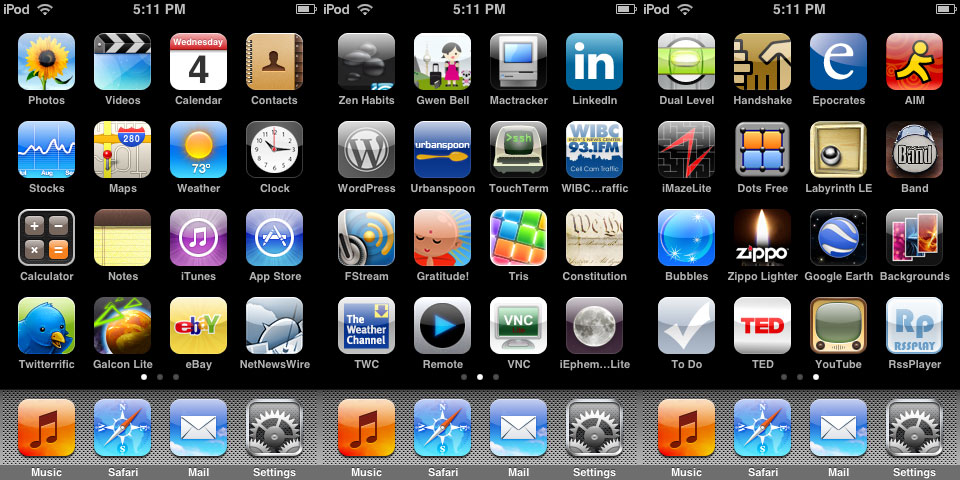
I hear tech pundits like Leo Laporte and Justine Ezarik bragging about how many pages of iPhone apps they have. I believe they are at somewhere around eight pages, with sixteen applications each, plus four in the dock at the bottom. I got up to four pages, with a few more apps spilling onto a fifth. This was a little overwhelming if I wanted to find a specific app and I could not remember where I had placed it. So I recently connected my iPod touch to my computer and did an inventory of what I needed and did not need to carry around with me. There were lots of easy choices. Before I knew it, I was able to eliminate nearly twenty applications and hyperlinks from my home screen. It was so satisfying to clean house like that and my productivity on my iPod touch has improved noticeably. (Notice Twitterrific, eBay Mobile, and Galcon Lite are now easily accessible on the first page for maximum efficiency.)
Below are screenshots of all three pages of my iPod touch home screen. It’s good.
At Macworld Expo 2009, Apple announced that it was officially dropping Digital Rights Management (DRM) on music sold in iTunes and it was making the vast majority of the music sold there available under iTunes Plus. This is a service that Apple began offering back in 2007. Songs are offered in 256-bit AAC encoding, and without copy protection. It is a widely held belief that the only reason Apple has clung to DRM for as long as it has is because the major record labels insisted on it, threatening to pull all of their music off of the iTunes Store, crippling it. To be fair, Apple had it’s own incentives to use their FairPlay DRM. Actually, just one: the iPod.
Apple released the iPod in 2001 and the iTunes Music Store went up two years later, in 2003. Before iTunes Plus came along, all content sold through iTunes was sold with FairPlay DRM. This not only restricted what the end user could do with the music on their computer, it also locked all of that content to the iPod. All FairPlay-protected content could only be played through iTunes on an authorized computer or through an iPod. This arrangement, while not being wholly equitable to the end user, proved successful nonetheless. iPod sales skyrocketed.
I believe that it is fair to say that the iPod dominates the American music player market with well over 70% marketshare. The iPod is not going anywhere. Many so-called “iPod killers” have come and gone over the years, most notably Microsoft’s Zune. None of the iPod’s competitors were able to knock the iPod off its pedestal. I do not believe that any one product will be able to knock the iPod out of the lead any time soon.
With Apple now dropping DRM-protected music and allowing current users to upgrade their protected music for thirty cents a song, iTunes music can be played on virtually and computer or portable player. I think that iTunes provides a good, convenient way to legally purchase music. The only major hiccup being that DRM restricted what you could do with it and where you could play it. I think that this move stands to make Apple a great deal of money in the long term from the iTunes Store. The interesting question to me is: how will this move affect sales of iPods?
As I mentioned earlier, the iPod is firmly entrenched in the portable music player market. People are used to it. They like it. Granted not everyone is a fan of the iPod. Not everyone is willing to buy one. The iPod may not be what some people look for in a music player. So, if you can combine the shopping and buying experience of the iTunes store with a wide variety of music players, besides the iPod, what effect will this have on Apple’s long-term business. I think it will definitely help music sales along on iTunes. On the other hand, it could hurt iPod sales a bit, where the money is really made.
Maybe I am wrong. Maybe the iPod is so resilient and entrenched in the market that an announcement like this will not do any real damage. This could even help iPod sales along, though I am not sure how.
Related links:
 Patrick Proctor was here