I am a college student. When I was in high school, Wikipedia became more and more popular as a source of information among my peers. I was among the few in my age group to be suspicious of Wikipedia. The thought of anyone being able to edit what so many consider absolute fact was frightening to me and still is today. Even today, as a junior in college, I see many of my peers regarding Wikipedia as the gospel truth on everything. It is a quick way to push actual research out of the way.
 I certainly think that Wikipedia has its place. I believe that it is excellent as a starting point for research, to point people in the right directions. I believe that it is good for looking things up quickly, when accuracy is not necessary or the subject in question is unimportant. I really love social media. I love how democratic the internet is and that everyone gets an equal voice. However, I think that Wikipedia is an exception to that rule. Everyone having an equal voice on Wikipedia may not be a good thing. Hacks, propagandists, vandals, and just plain idiots can post anything they like on Wikipedia. Since so many people take Wikipedia so seriously, it has the potential to become a frighteningly powerful tool for misinformation and propaganda.
How would I approach Wikipedia? With caution. Everything that is printed there should be taken with a grain of salt. I would not use it as a source for a paper or some other assignment. I do use it for research. I use it to give me a general idea of the subject at hand and then use the references at the bottom of the article to find better, more accurate information that will probably become by cited sources.
I think that Wikipedia has its place in academia, but that place is not as a primary source. It is a search tool and can be used for a very limited summary on a given topic, no more. We have to be very careful about what we read an believe on the internet, as well as what we repeat and pass on to others.
According to a story on MacRumors, the new unibody 17-inch MacBook Pro has started shipping after being announced at Macworld earlier this month. Apple has updated it online store page to show this.
At Macworld, Apple rolled out a a few things. Among them was the new 17-inch MacBook Pro. This new MacBook Pro is about the same size and weight as the old model. It has the same black-bordered, glossy screen and unibody enclosure as the new MacBook and 15-inch MacBook Pro. The big thing that separates this 17-inch computer from its predecessor is the fact that it has built in battery that cannot be removed by the end user without opening the case and voiding the warranty. According to what Apple is saying, this allows for a maximum battery life of eight hours per charge and allows the battery to be charged three times more than their older laptop batteries.
So, let’s weigh the pros and cons, shall we? We get increased battery strength and overall life in exchange for the loss of the convenience of being able to put in a new battery without needing to recharge. Many professionals make a habit of carrying an extra laptop battery or two, especially in cases where they will not be able to recharge, like when taking a trip or flying on an airplane. For these people, the lack of an easily removable battery could very well be a deal-breaker. For me, this would not be a problem, as I rarely find myself away from an electrical outlet for any meaningful length of time. The deal-breaker for me in this case is the price; the 17-inch MacBook Pro starts at $2,800. But that is beside the point. Is the 17-inch MacBook Pro for everyone? No, certainly not. It is for everyone no more than the MacBook Air is for everyone.
Apple tends to make certain design decisions that are controversial in the beginning and that controversy can linger for years, despite compromises and refinements in that decision. One example would be Apple’s decision in 1998 to make a desktop consumer-level computer without a floppy drive, the first iMac. This was a pretty big deal when it happened. But then media got cheaper and cheaper and the variety of USB-connected storage media grew so much that everyone abandoned the floppy drive. Apple makes a habit of trying out a feature on one of its computers and often expands that feature to the rest of its lineup over the course of several months. I believe that we will begin to see more integrated batteries in Apple’s laptops. It started with the MacBook Air, then the 17-inch MacBook Pro. How long will it be before we start to see this feature pop up in the 15-inch MacBook Pro or the MacBook?
I do not believe that Apple could get away with making the integrated battery a standard feature on all of its laptops, ceratainly not the 15-inch MacBook Pro. The MacBook Pro is a professional laptop and, as I stated earlier, many professionals like to swap out the battery rather than waiting for it to charge. This would be a feature better suited for the MacBook, where people will not mind so much about getting two or three extra hours out of a battery charge, then being tethered to a wall for an hour. Personally, I would love to have a 4.5-pound MacBook with six or seven hours of battery life. I really only needed to swap out the battery in my current MacBook after it reached the end of its life.
So, as with most of Apple’s decisions, the decision to integrate the battery into a laptop is one that will not make everyone happy. I believe it is a solution better suited to its smaller, consumer notebooks. The MacBook Air needs an integrated battery simply because it does not have enough internal space to accomated all of the connectors and latching mechanisms associated with removable batteries. The 13-inch MacBook could use it because the average consumer who buys the MacBook would probably not mind the integrated battery as much as a professional would and would greatly benefit from the extended battery life. It is my opinion that the integrated laptop battery is here to stay.
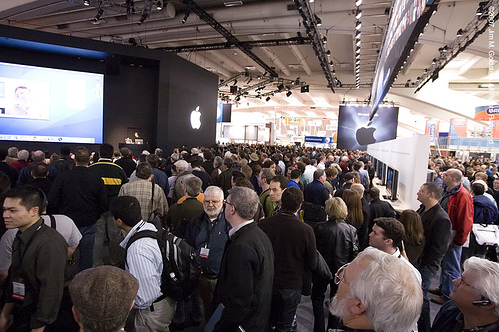
Apple announced that it will not be attending Macworld Expo after 2009 because they feel that their own retail stores and special events are a much better way for Apple to reach its customers, rather than trade shows. For those who keep themselves in the loop about these things, this is not news. In addition, Steve Jobs abstained from doing the keynote, something that he has done every year since 1997. Phil Shiller, Apple’s Senior VP of Worldwide Marketing went to Macworld to represent Apple and did a fantastic job. What does this mean for Macworld?
Recently, Steve Jobs temporarily stepped down from his regular CEO duties to recover from a hormone imbalance that has left him very thin. (By the way, Apple now boasts the thinnest, lightest CEO in the industry.) Tim Cook, Apple’s COO has stepped into the CEO role while Steve is away. Apple without Steve Jobs is still Apple. If Jobs left the company permanently, would it affect Apple’s ability to roll out great new products? Jobs left the company before, in 1985. It went downhill until he came back. Have things changed? Certainly. Apple has lots of creative, intelligent people who are fully capable of running the company. Also, products like computers, iPods, and iPhones are in the pipeline for at least one or two years. Even if Jobs is gone for that long, Apple will do well. I would also like to think that Apple’s leadership has learned from the mistakes of the past. Apple became complacent and created vast, confusing product lines. It even had four CEOs in the span of five years. I would presume that those fatal errors would not be made again without Steve Jobs at the helm.
My point is that if Apple is still Apple without Steve Jobs, then Macworld will still be Macworld without Apple. I think that the face and spirit of the Expo will change, but not the fact that it will remain a place for Mac fans from around the world to gather once a year. Up until now, Macworld has been your ordinary trade show and conference, albeit exclusively devoted to the Mac and Apple. It has attracted the mainstream media and gained even more attention than CES, which is held in Las Vegas at the same time. I think that with Apple gone, Macworld 2010 will not garner as much attention from the mainstream media. However, I think this is an opportunity for Macworld Expo to become a more niche gathering, where people who love to use the Mac, or people who want to learn more about the Mac to converge on one spot once a year. It will cease to be a press conference for Apple and focus more on the Mac user. That is my vision for the future of Macworld Conference & Expo.
Macworld 2010 has already been confirmed by IDG, the group that organizes the convention every year. The Moscone Center has been booked up for five days in January 2010. The stage is set, so who will be there and what will they make of the event? Will there be a Macworld 2011? I certainly hope so and I think that there is a very good chance. I believe that with Apple departing, the Mac users themselves who attend the show year after year will have a chance to reinvent Macworld Expo into something that is about the average Mac user.
As I type this, I am sitting in the kitchen around 8:30 AM on January 20, Inauguration Day. I am watching C-SPAN’s coverage of the Inauguration Ceremony. Of course, it has not started yet, but they are covering all of the people showing up and the Obamas’ itinerary through Washington. It is very exciting. I still cannot believe that George W Bush is only hours away from unemployment. While I was watching the coverage, I noticed something in the ticker at the bottom on CNN. It said something about the majority of African-Americans believing that Martin Luther King Junior’s vision has been realized. This caused some internal discussion about that assertion.
Before I go further, I should probably be fair and state that I am white, I was born nearly twenty years after King died, and I have never had to face racial discrimination. That said, I think that I should try to make my case about why Dr. King’s vision has not yet been realized. Simply put, his vision was not just one of racial equality for all people, but also economic equality. I believe that those to go hand-in-hand, to some extent. We have a widening income gap in this country, which is one of the things that I hope President Obama will fix. Until that income gap issue is resolved, there are mechanisms in place that can help people lift themselves out of generational poverty, and this country’s education system is vastly improved, I see no real way of fully realizing Dr. King’s dream.
I think that King’s vision of a country that is not divided against itself and where everyone has an equal shot at achieving his or her dream is a very admirable one. However, it is not one that can be easily realized. King was assassinated in 1968, over forty years ago. Granted, we have come a long way since then in the areas of race relations and economic equality. However, I still believe that we still have a way to go.
If you say something is done, you are wrong. There is always room for improvement, especially when it comes to securing economic equality for everyone. It is not a task that will be complete for a long time, if ever.
I usually find myself stressing out or berating myself for things that don’t matter. I often lose sight of the things that are okay with my life. Today is going okay for me. I made some time to go to one of my favorite local restaurants, something I don’t do often.
When I was done with my meal and headed out, it occurred to me: I have it pretty good. If anything, today is really good. I had some great Cajun food in downtown Indianapolis. Then I got in my car and headed out for the first day of graphic design and programming classes. I am healthy. I have a home. Maybe my life is a lot better than I often realize.
 Patrick Proctor was here