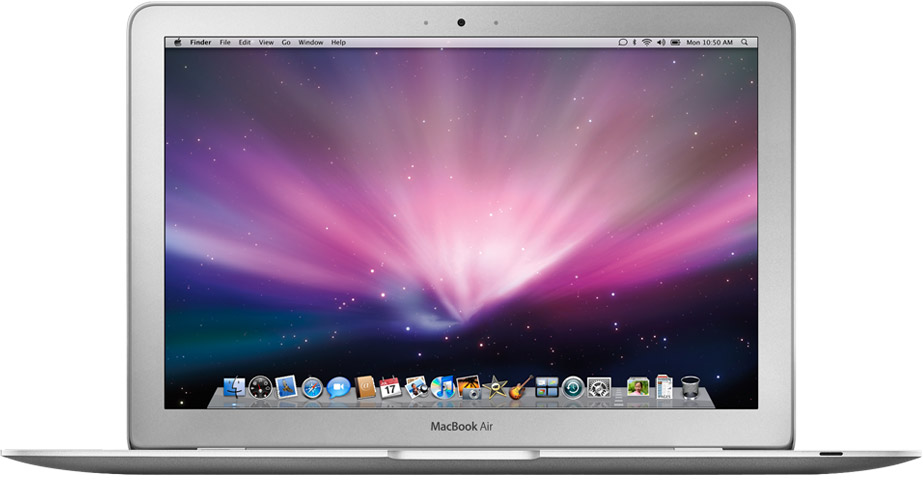
Let’s face it, laptop computers and other electronic devices are getting smaller, thinner, and more powerful everyday. Computers like the MacBook Air are a good example of how compromise on functionality was required to make the device as thin and light as it is. It is 0.76 inches thick and tapers off 0.16 inches and weighs in at three pounds. However, significant compromises and a custom processor from Intel were required to make this a reality. The
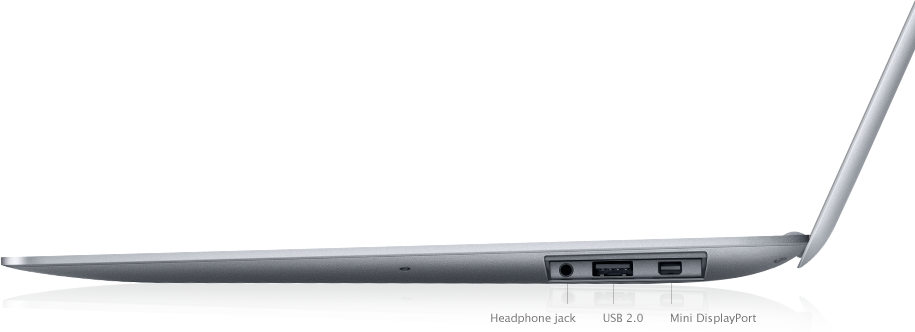
computer has a customized power cable. It has room for either a 160-gigabyte hard disk or a 128-gigabyte solid-state drive, nothing more. It can only come with 2 gigabytes of RAM. There is a video-out connector, either Micro-DVI or DisplayPort. There is an audio-out port and a single, solitary USB 2.0 port. Only one! Of course, the Air is too thin to include an optical drive. This only becomes a problem if you want to import an audio CD, watch a DVD, burn a disc, or install software from an optical disc. Apple offers a USB-connected optical drive for $100. Also, there is no ethernet port. All networking is done over 802.11g/n wifi.
I hate to sound like I am bashing Apple or the MacBook Air. I love the MacBook Air. I could live with its compromises and would love to own one. I think Apple is an extremely innovative company that makes lots of great, high-quality products. I just felt it was important to illustrate the compromises made in order to make an ultracompact computer to prove my point.
My point is this: wireless data transfer rates are high that simple file transfers can easily be done wirelessly in most situations. It typically has a throughput of 74 Megabits per second. In my own opinion, that is fast enough to move music, standard-definition movies, and software around with relative ease. Larger files might be better left overnight to transfer. However, like most thinks technological, wireless networking continues to evolve and data throughput will only continue to get faster.
That’s wifi. Then there are technologies like Wireless USB and Bluetooth. These have a much shorter range than wifi. Bluetooth 2.0 +EDR has a maximum speed of 3 Mb/s and Wireless USB 1.1 will have a theoretical maximum speed of 1.0 Gb/s. So, this allows devices that are enabled for either of these technologies to exchange data very quickly when they are in close proximity. For most cases, this is when a computer and a phone or PDA are sitting on a desk next to each other.
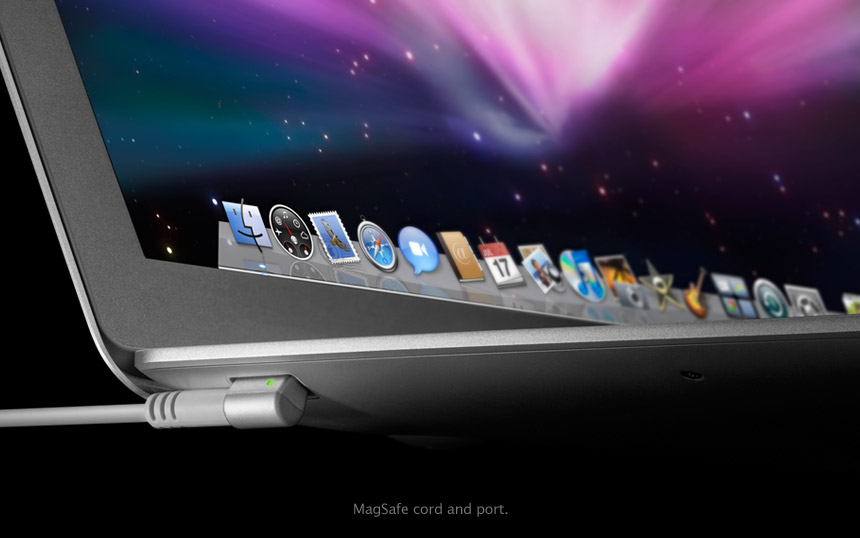 Now, that’s data transfer. What about power? Power ports are huge issue because they take up space, both inside and outside. This puts a minimum thickness requirement on what ever device the power port is installed. Apple was able to (somewhat) work around this by curving the bottom of the MacBook Air, putting the MagSafe port on the bottom and including a 90-degree bent power connector. Since all electronic devices need to be powered, a power port has always been a necessary evil and will continue to be for at least several years. There are currently companies like WildCharge who are creating induction-based charging systems for consumer electronics. This would allow for a device to be placed on an inductive charging surface and charge with out cables. Unfortunately, this technology has yet to receive wide adoption and WildCharge’s own website only offers solutions for three mobile phones, the Motorola Razr and Blackberry’s Curve and Pearl.
Here is my vision for compact electronics and ultracompact notebooks. I see them moving away from conductive charging systems (power adapters, cords, etc.) and into inductive charging systems. Imagine simply having a small pedestal that you put your mobile phone, iPod, and notebook onto when you get home. It charges even faster than the old charging systems. You don’t have to keep track of cables or having your outlets filled up with chargers. Without all those power cables running around, there is less clutter in your work area. There are fewer cords to trip over. There is zero risk of accidental electrocution. The convenience goes even further because it is now possible to install inductive charging systems in tables, desks, and countertops. You can just set your notebook down on the kitchen counter and it starts charging.
As for pushing files around, again, you have less clutter. No more cables and ports, remember? Wireless technologies have advanced to the point where you can surf the web, download and upload files, and transfer contacts, photos, music, and video around your house without plugging in a single USB or Ethernet cable. Since phones already have Bluetooth and have used it successfully for years, it is a simple matter of moving into our mp3 players like the iPod and the Zune.
I realize that some of the advances I am seeing would take a while to successfully implement. Induction power systems are a reality today. Some of the advances in data transfer technology are still a few months or years off, but they are coming and they will be affordable to nearly everyone. Without the need to build ports into our lightweight compact devices, we will no longer have to make so many compromises and these stripped-down notebooks will become even more appealing. I seriously hope you will give the next few years of hardware evolution some thought. I would welcome any thoughts you may have on the subject.
I am absolutely positive that 99.99999% of Americans (and perhaps world citizens) know that Barack Obama was elected the 44th president of the United States last week. His victory was so strong and decisive that he even won my home state of Indiana, albeit by a small margin. This was undoubtedly a huge and important election. This presidential election had been running in excess of 20 months by the time Election Day rolled around on November 4. I wanted to write soon after the election to accurately capture my feelings andpe
rspectives on the 2008 election. Of course, I am a chronic procrastinator and put it off until November 9. On the other hand, it gives me some time to cool off and see how things have shaken out since the end of the election.
Let’s start at the beginning. At the beginning of this presidential race, I was an outspoken supporter of Dennis Kucinich. Go ahead and laugh at me. Everyone does for that, but I felt like he had the best of philosophy out of all the Democratic candidates. At least, he was the one I agreed with nearly 100% of the time. He did not have much in the way of policy, but few of the candidates did early on. Eventually, the candidates started dropping like flies, and Kucinich was not spared. His campaign ran out of money and was given very little press or face time, even during the debates that were being held then. So, Denny was out. Who then? I was still a little resentful of how his campaign was being handled by the media. I saw that of the eight or candidates, Barack Obama and Hillary Clinton were being given the most attention by the media. I felt it was like the media was focusing on the novelty of a black man and a white woman running against each other. As the race rolled on, I chose Barack Obama as the next logical choice. He was as outspoken for peace as Kucinich was, but he seemed to be relatively liberal, calm, and even-handed. So, thus Obama became my choice for President in 2008.
Like the rest of America, I watched the presidential race unfold. John Edwards got knocked out of the race. On the Republican side, John McCain was left the last man standing. (The GOP made the decision to field only old, white, Christian men this time around.) As expected, I was repulsed by the Republican candidates. I was so upset with what the Republicans had done to our country since George Bush was elected in 2000 and 2004, that did not really expect them to win, anyway. I had thought, incorrectly, that maybe the Republicans would have softened up on some of the positions and maybe become a little less conservative. I have to say I was a little disappointed. I know that many people in the Republican party are very smart and maybe would have realized their chances on 2008 would be better if the compromise a little. If there had been those voices, they were obviously disregarded. During one of the GOP debates, the candidates were asking of any of them did not believe in evolution. Three, count ’em three, of the candidates raised their hands. When I saw this on TV for the first time, I couldn’t believe it! One of these men could have ended up running our country. To me, that only demonstrated, yet again, the profound lack of a grip on reality that has plagued the Republican party for years. People do try to argue with me on that point, and they are wrong. Bush is a prime example. Despite all of the warnings, despite all of the advice, and despite all of the intelligence the showed there were no weapons of mass destruction, President Bush insisted on invading Iraq. Iraq had nothing to do with the attacks of September 11, 2001. Iraq had no weapons of mass destruction. Iraq was of no threat to the United States, but the president insisted he knew better and invaded. This shows a critical lack of reality-based thinking. I do not want an ideologue in the White House. I want a critical thinker who is flexible, well-informed, and open to suggestions. I did not see this in the GOP, not now anyway.
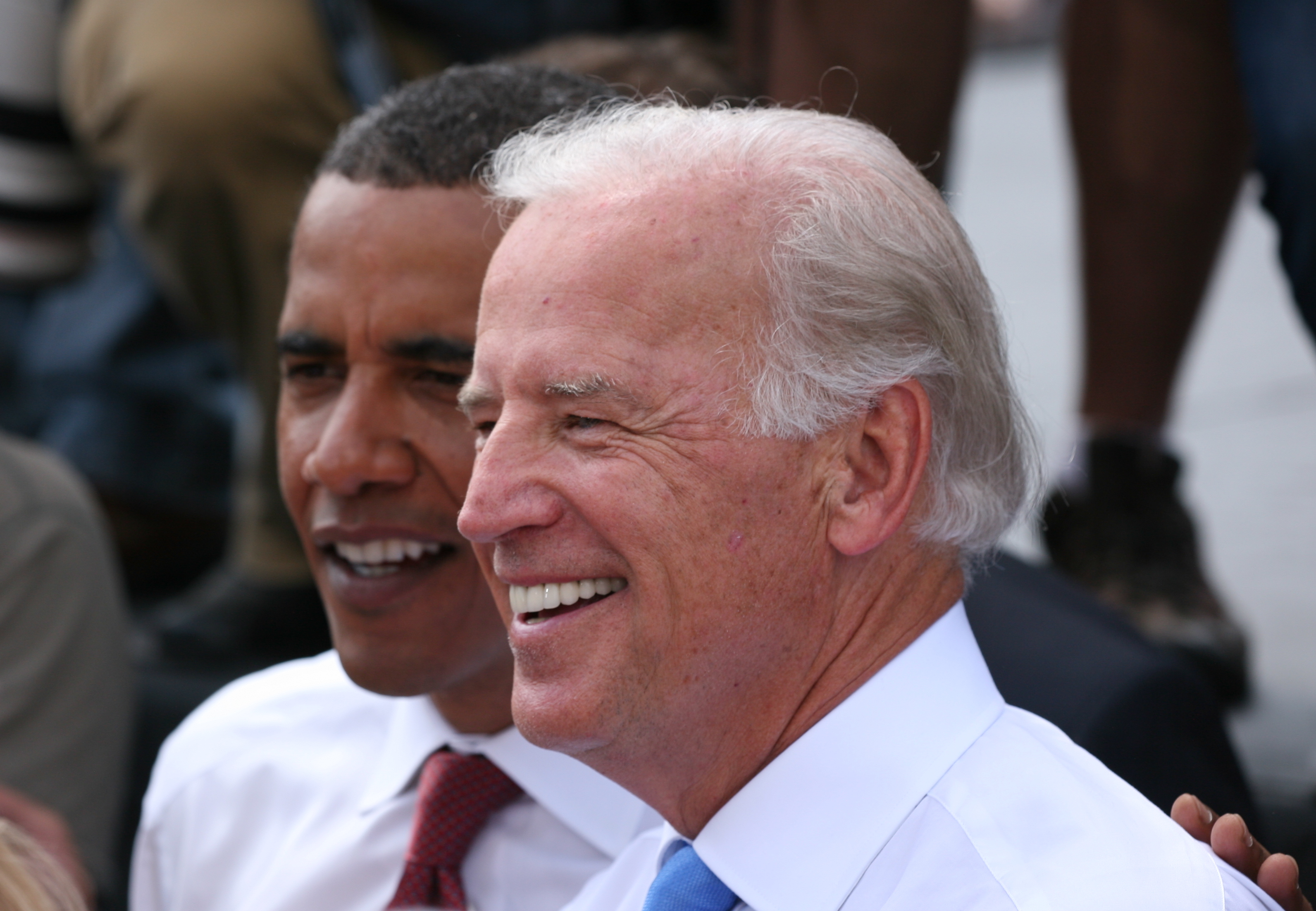
The battle for the Democratic nomination raged into the summer of 2008. Then she suspended her campaign on June 7, 2008 and endorsed Barack Obama. With that, Obama became the presumptive nominee, later confirmed by the Democratic National Convention in Denver in August. Indiana’s primary in 2008 was in May. I voted for Obama to be the nominee in that primary. I voted for him because I felt that both candidates were very similar politically, but Clinton was much more polarizing and less calming than Obama. Political polarization was not something this nation needed more of, in my opinion. So, Senator Obama had my vote. Senator John McCain later was confirmed as the Republican candidate for president. At the DNC, Obama named Senator Joe Biden as his running mate. Likewise, at the RNC, McCain announced Governor Sarah Palin as his running mate. I remember much more fuss being made by the media over Palin’s nomination than Biden’s. This was perhaps because Joe Biden is much experienced that Sarah Palin. Palin had been Governor of Alaska for less than two years, roughly the same length of time that this race had been running. A major argument that the Republicans had been making up until that point was that Obama was too inexperienced to be an effective president. It seemed like those arguments had largely subsided after Palin’s nomination.
The race after the conventions became increasingly intense. The Republican candidates relied more on rallying their base, using scare tactics, and using negative campaigning that the Democratic candidates. The Democratic candidates seemed to stick to the issues. They focused on what set them apart from their competitors and made them the better choice, rather than taking cheap shots. It wasn’t just the more progressive political leanings of the Democratic candidates that won me over. It was the fact that they were making well-reasoned, logical arguments. In my own opinion, it was this that gave them a major advantage.
Election Day was an exciting day for me. I woke up at 7am, which is very early for me. I drove over to my polling place, unsure of how long the line to vote would be. The line for my precinct was much longer than the other three precincts represented at that polling place. I waited in line for over an hour and fifteen minutes. It wasn’t a terrible wait. It was made much easier by all of the butterflies in my stomach. I finally reached the people doing the rolls. I checked in. I waited for one of the voting booths to open up. I cast my ballot. There is a list of some of the offices and positions that I voted for. The machines were digital. No touchscreen, though. There was an LCD screen with a row of buttons on the left and right sides of the screen. I felt like the whole voting process was easy and straightforward. I went home and checked the polls. I had CNN on TV while I ate lunch. I arrived at work just before 1pm and left just after 7pm. The whole time, I couldn’t stop checking the polling results and I started getting very excited when the first poll results starting coming in, including results for Indiana. At first, Obama had Indiana, but McCain held onto it for most of the night. I drove home as quickly as I could. I didn’t even eat a proper dinner that night, just half a bag of chips, leftover Halloween candy, and a couple cans of Pepsi. I was glued to the results. I posted results for electoral votes and the poll percentages for Indiana constantly on my Twitter and my Justin TV page.
Around 11pm on Tuesday, November 4, 2008 the election was called for Barack Obama. Obama was now the forty-fourth President Elect of the United States. I was thrilled! Of course, I was outwardly subdued, as I usually am, but inside I was jumping up and down, completely elated. I waited about an hour for Obama’s acceptance speech. It was mostly an expression of gratitude towards everyone who had helped him win. He also made unity a major point of his speech. During McCain’s concession speech, the crowd booed many times and was not nearly as graceful as either candidate. This election obviously created some vitriol among a significant number of McCain/Palin supporters.
At the end of the day, I was filled with optimism for our country that I had not felt in a long time. I have been long frustrated by the state of politics in this country. I cannot remember a time when the Democrats had control of the White House and decisive control over Congress. If the Democrats have the potential to be as productive as the Republicans were when they had control, I think we are going to see some really great things coming out of Washington starting January 20, 2009.
- President: Senator Barack Obama (D)
- Governor: Jill Long Thompson (D)
- US House Rep. (Indiana’s 5th): Mary Etta Ruley (D)
 Patrick Proctor was here
  Now, that’s data transfer. What about power? Power ports are huge issue because they take up space, both inside and outside. This puts a minimum thickness requirement on what ever device the power port is installed. Apple was able to (somewhat) work around this by curving the bottom of the MacBook Air, putting the MagSafe port on the bottom and including a 90-degree bent power connector. Since all electronic devices need to be powered, a power port has always been a necessary evil and will continue to be for at least several years. There are currently companies like WildCharge who are creating induction-based charging systems for consumer electronics. This would allow for a device to be placed on an inductive charging surface and charge with out cables. Unfortunately, this technology has yet to receive wide adoption and WildCharge’s own website only offers solutions for three mobile phones, the Motorola Razr and Blackberry’s Curve and Pearl.