No, you not misread the title. I did imply Indiana should switch to Pacific time. Why? Why else would I suggest something this expensive and grandiose? Because it fits with my own selfish needs and desires. Hey, that’s why our own Governor, Mitch Daniels, got Indiana to adopt daylight savings time in 2006. But this blog post is not about Mitch Daniels and all the boneheaded moves he has made during his term as governor of Indiana. No, like many things, this is about me.

I have kind of a bizarre sleep schedule by Indiana standards. I go to bed around 2am. Wake up around nine or ten o’clock in the morning and then go about my day. I can get away with this because I work in the afternoon primarily and all of my classes are either in the late afternoon or early evening. I have taken flak for this, especially when I was in high school. Classes started at 7:30 in the morning, requiring me to be up by 6am. This made reconciling academic success with my sleep schedule highly problematic.
Recently, I came to a realization. To borrow a quote from Star Trek, “If there’s nothing wrong with me, then there must be something wrong with the universe!” I realized that I am not really a nocturnal person. I am actually a normal person who has been operating in a different time zone all along! So, when you go through my schedule again, it all makes sense. I go to bed around 11pm. Wake up around six or seven o’clock in the morning and then go about my day. For my Tuesday shift at work, I’m not showing up at 1pm, it’s really 10am. This morning, I a really early riser. I woke up at 4:30am (7:30am ET) and was at work by 7am. I am such a hard worker!
So my case is this, by switching to Pacific time, everyone will be three hours early. Of course, we can’t simply pass a law to make it official. No, leave all the office and classroom clocks alone. We should all operate on Eastern time, but think of it as Pacific time. That will carry people like a long, long way.
If you are confused, I understand. I cannot say I understand it entirely myself. Time zones have that effect on people. At least they’re good for the occasional bizarre blog post.
Greetings, fellow technology enthusiasts. We all use something different, Mac, Windows, or Linux, iPod, Sansa, or Zune. I think that we can all agree that the iPod has made an idelible mark upon the technology industry.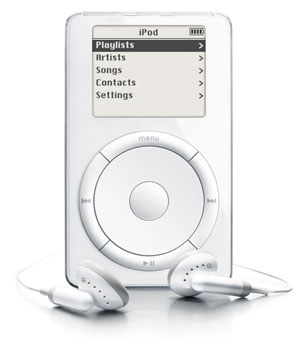 On October 23, 2001, Apple introduced its own music player, the iPod. It cost $499 and had a 5 gigabyte hard drive and a non-backlit black-and-white LCD display. The iconic “Click Wheel” on the front was called the “Scroll Wheel.” Ironically, though, the wheel really did make a light clicking noise. Nowadays, we are used the iPods having a touch-sensitive wheel on the front. The original had a physical wheel that moved around.
Apple was certainly not the first to market in this area. Companies like SanDisk, ZEN, and Sony all had their fingers in this market. What really won over the masses was not its technical ability and certainly not its price. It was the user interface. Most of the established brands all had devices with similar storage and lower prices, compared to the iPod. However, their user interfaces were clumsy and had a difficult learning curve.
The iPod not not take off right away. In fact, it took a few years for it to really catch on and start growing market share. It is still growing market share. The positive impact of the iPod has helped to generate a “halo effect” around Apple’s other products, especially the Macintosh. In fact, during Q4 of 2008, Apple reported that it sold 2,611,00 Macs, 6,892,000 iPhones, and 11,052,000 iPods. With each of those categories, Apple expanded its marketshare.
Not everyone is as big a fan of the iPod as I am. Part of Apple’s strategy was selling the iPod as a companion to its online media service, the iTunes store. Originally it only sold music. Now it sells movies, music videos, TV shows, games, and iPhone applications. The problem that many have with this service is its employment of Digital Rights Management, effectively locking the music to the iPod and the computer it was purchased on. The primary reason that Apple gives for doing this is that it would have been impossible to get content from the major record labels without putting copy protection on their content. It has partially responded by introducing iTunes Plus, music sold on the iTunes Store, but with a higher bitrate and not DRM.
Another criticism is the lack of a consumer-removable battery. The lithium-ion battery in the early iPods tended to have a high failure rate, frustrating customers who wanted a quick and cheap way to get their iPods portable again. Apple offers battery replacement for a fee. (I believe it is $50.) Also, when Greenpeace began drawing attention to Apple’s questionable environmental policies, Apple began an iPod takeback program. Apple will now take back any iPod for recycling, free of charge, even if you do not buy a new iPod. They also have a similar program for Macs, but you do have to purchase a new computer to recycle it through Apple.
Despite its flaws and criticisms, the iPod remains an excellent media player for the general public, myself included. I own a fifth-generation iPod and an iPod touch and I have enjoyed them both. In fact, I am thinking about getting my old iPod out of storage and putting Rockbox on it. I would say the iPod has had an excellent seven years and I think it has several more to come.
About two weeks ago, I decided that I would try using WebKit as my primary browser. I have to say, the experience was very positive, for the most part. For those unfamiliar with WebKit, it is the open source application framework that is being used as the foundation for several current browsers. Among them are Apple’s Safari (including the  version being used by the iPhone and iPod touch), Google Chrome, and mobile browsers from Google and Nokia. Of course, that isn’t a definitive list of all the companies contributing to the WebKit project. More information is available on WebKit’s site.
Every night, a new build of WebKit becomes available in an RSS feed. They have versions available for Mac OS X and Windows, as well as the source code itself. I only downloaded nightly builds three times, with little noticeable difference between them. If you are on a Mac and using Safari, you know that Safari is really fast and loads pages very quickly. When running WebKit, it’s even faster. Plus Webkit scores 100 out of 100 on the Acid3 test, a measurement test for a browser’s JavaScript performance.
While running some sites, WebKit did crash where Safari never did. This is probably because Safari is a finished, stable product where WebKit is not. I do not recall the error messages I received. However, these crashes only occurred two or three times and did not really affect me too much.
In Mac OS X, you launch WebKit using a typical icon. The icon looks just like the Safari icon, but with a gold rim and a purple background, where Safari is silver and blue, respectively. I do not understand how WebKit works exactly. I do not believe it works as its own application, because it shows “Safari” in the menu bar. You really would not guess you are running something other than Safari, because the interface is the same and all of your bookmarks and history remain.
If you have not tried WebKit, I recommend it. It is a free download and easy to install. If you have used Safari, you should feel right at home in WebKit. All in all, I would give this great browser a shot.
This story was found by way of Ars Technica:
Australians may not be able to opt out of the government’s Internet filtering initiative like they were originally led to believe. Details have begun to come out about Australia’s Cyber-Safety Plan, which aims to block “illegal” content from being accessed within the country, as well as pornographic material inappropriate for children. Right now, the system is in the testing stages, but network engineers are now saying that there’s no way to opt out entirely from content filtering.
Apparently, the Australian government has taken it upon themselves to filter out what they deem to be “illegal” content. This is exactly what the Chinese government is doing with its Great Firewall. The reasons for doing it and the methods they use may be different, but the end goal is still the same. There has already been some backlash amongst Australian internet users. Despite these protests, the Australian government is still pushing forward. Despite their best efforts, though, this may not have the desired impact, as the internet is impossible to regulate.
What I find most troubling about this is the fact that it could spread. With things like Homeland Security and the USA PATRIOT ACT gradually whittling down our freedoms in the United States, how can we be sure that our freedom and privacy on the web will be preserved. The web is the most egalitarian media outlet ever created and laws like this just damage it. One of the web’s greatest strength’s is that it is unfilitered. Anyone can post anything and anyone can get anything (for the most part). To have that kind of freedom and openness diminished by governmental regulation and censorship is sad and frightening.
I can understand the desire to censor things like child pornography. In fact, I am okay with blocking things like that. The web can be used for lots of bad things. However, I feel that the web is largely used for positive purposes. Also, whenever a government is given a certain power, it is rarely taken away from it. This also gives the Australian government enormous power to control what its citizens see on the web. Regardless of what the says the government can and cannot do, there will probably be individuals who take advantage of that power for their own ends.
I hope public outcry will kill this government action in Australia and prevent it here in the United States. The strength and appeal of the internet lies in its freedom. It is my contention that there should be at least one media outlet that is completely free of censorship and regulation. I would urge Australians to speak out and for Australian ISPs to grow spines and stand up to this. Sorry, Australia. I hope you feel better soon.
Attention please, ladies and gentlemen. I need help. You see, during the warmer months of the year, I race my own outboard hydroplane. It’s a lot of fun and is a hobby I have enjoyed since I started racing in 2001 at the tender age of 13. I have had my boat (pictured) for seven years and it is time to repaint.
This is where my challenge comes in. I cannot decide which color(s) I should paint my boat. I have been wracking my brain and considering all kinds of options. Our racing team colors are black and yellow. Silver can be a little hard to spot at a distance. Lots of people are doing blue and green. I kinda like the current color scheme on my boat as it is now, but it’s probably time for a change.
So, my challenge to you is to submit your color choice/scheme suggestion in the comments to this blog post. The winner doesn’t really get anything, other than my thanks for helping out. So, will you help me make up my mind?

42h (me)
Whew! I can’t believe I left my blog alone for this long! I will try to make writing here a more regular thing. I realize that nobody really reads my blog but it helps me. Of course, if you are reading my blog, please leave me a comment. I don’t care if I know you or not, I just want to know that someone is reading this. Lots to catch up on!
School is going well. I am taking five classes, with a total of 17 credit hours this semester. It certainly is a handful, but I think I will come out of it with at least a B average. Below is a list of the classes I am taking.
- INFO-I201: This is a logic class. Lots of ifs ands ors and thens. Then there are the truth trees, which are hella fun, in a strange way.
- INFO-I210: This is a PHP programming class. Again, another class that is hella fun. I am learning a programming language that will undoubtedly become a valuable asset to me in the future. I will take the second part of this course, INFO-I211 next semester.
- INFO-I303: This is a class that I am taking over the web. It’s not too bad. There are a few long-term projects that have me worried. In this class, we are basically trained not to be the nerd we are in front of the boss.
- CSCI-N305: This is a C programming class, again taken over the web. Pretty challenging, moreso than the PHP class because I cannot simply talk back to the instructor.
- NEWM-N110: This is a usability course. We are trained to make sites attractive and easy to use, unlike some other sites.
Work is going well too. I work on campus for UITS in the STCs. Unfortunately today, I racked up four attendance points because I slept through my alarm and was 46 minutes late to my shift. Oh, well. I do not think I will happen again, other than that, I am enjoying my work. It is not too challenging, my work schedule works around everything else, everyone is really nice, and oh, I get paid. Right now, I am being paid $7.50 per hour. Next semester, it will be raised to $8.00 per hour.
I have started a new project. It’s pretty much just your average run-of-the-mill “photo a day” deals. So far, I am keeping up, but I am terrible at staying with things like this. The photos are going up on my Flickr account.
 Patrick Proctor was here
